The Rise of Chinese Automakers: How China Is Reshaping the Global Automotive Industry
The global automotive industry is undergoing a profound transformation. From battery dominance to software innovation, explore how Chinese automakers have transitioned from market challengers to global leaders, rewriting the future of mobility in Europe, Latin America, and beyond.
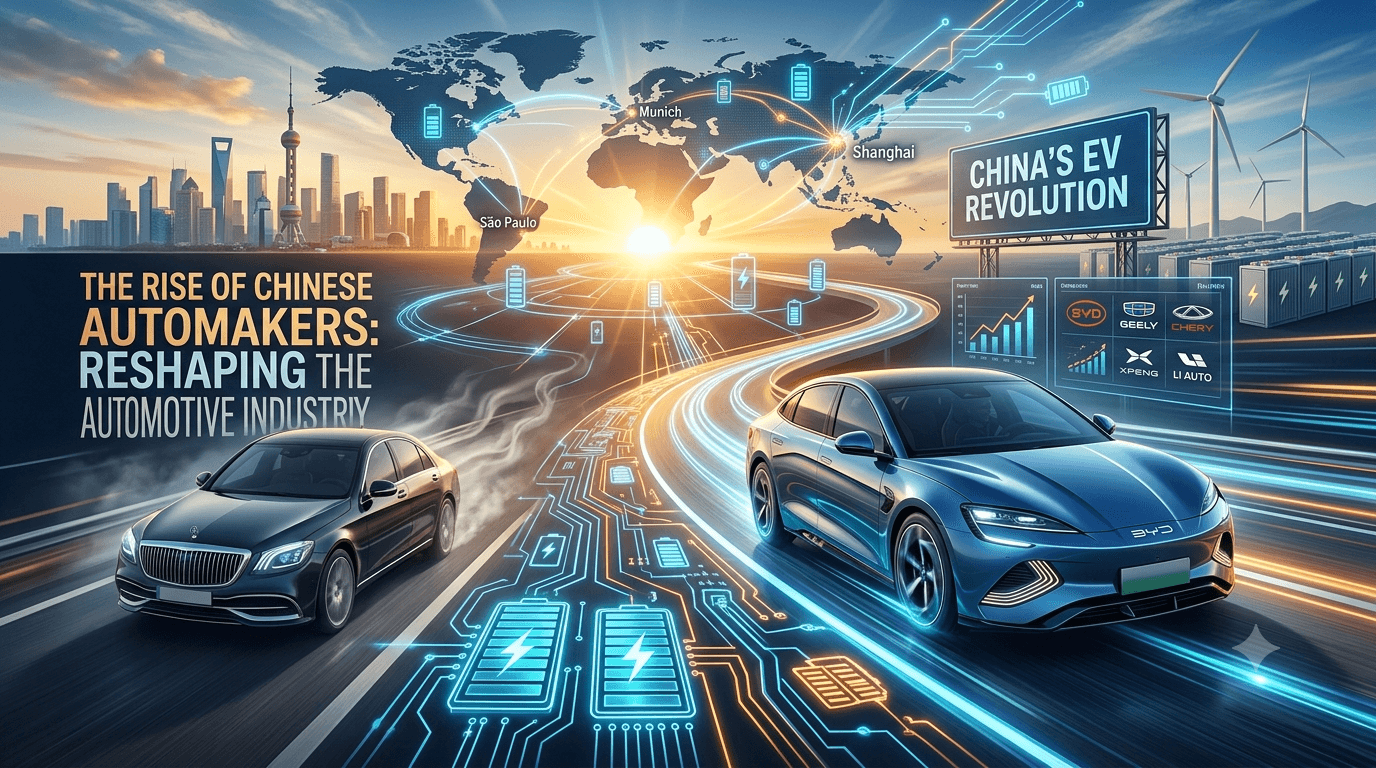
📌 Chinese Car Manufacturers Are No Longer Emerging Players
Over the past year, one of the most significant stories in the global automotive industry has been the rapid rise of Chinese automakers. What was once viewed as a domestic success story has evolved into a global transformation, with Chinese brands expanding aggressively into Europe, Latin America, the Middle East, Southeast Asia, and beyond.
Companies such as BYD, Chery, Geely, XPeng, Li Auto, Zeekr, and Leapmotor are no longer competing solely on price. Instead, they are increasingly leading in:
- Electric vehicle (EV) technology
- Battery innovation
- Advanced software integration
- Intelligent driving systems
As a result, traditional automotive powerhouses in Europe, Japan, South Korea, and the United States are facing an unprecedented level of competition.
📈 BYD's Global Expansion Signals a Shift in Industry Leadership
Among all Chinese manufacturers, BYD has become the definitive symbol of China's automotive rise. During the past twelve months, the company continued to expand its global footprint and strengthen its position as one of the world's leading electric vehicle manufacturers.
Industry analysts have noted that BYD's international sales growth has significantly outpaced many established competitors. The company's expansion strategy masterfully combines:
- Advanced battery technology
- Competitive pricing models
- Vertically integrated manufacturing
- Rapid product development cycles
In June 2026, BYD's leadership publicly stated its ambition to become the world's largest automaker within the next five years. Such a statement would have seemed unrealistic only a few years ago; today, many industry observers consider it a highly credible long-term objective.
🇪🇺 Europe Has Become the New Battleground
Perhaps the most important development over the past year has been the growing presence of Chinese brands in Europe.
Despite intense regulatory scrutiny and additional tariffs on Chinese electric vehicles, Chinese automakers have continued to gain market share across major European markets. Industry data shows substantial increases in registrations for brands such as BYD, MG, Chery, and Leapmotor.
Key Milestone: A major shift occurred when BYD surpassed Tesla in electric vehicle sales in certain European markets during parts of 2025. This event was widely covered by automotive media and highlighted how quickly competitive dynamics are changing within the EV sector.
European consumers are increasingly attracted by the combination of advanced technology, long driving ranges, modern interiors, and competitive pricing offered by Chinese vehicles.
🧠 Technology Is Driving China's Automotive Success
One of the most important pillars behind the success of Chinese automakers is their laser focus on technology.
Unlike traditional manufacturers that often evolved from mechanical engineering backgrounds, many Chinese automotive companies were built during the digital era. This has allowed them to integrate software, connectivity, artificial intelligence, and user experience into vehicle development right from the blueprint stage.
Modern Chinese vehicles frequently feature:
- Advanced Driver Assistance Systems (ADAS)
- AI-powered voice assistants
- Over-the-air (OTA) software updates
- Large digital infotainment displays
- Smart connectivity ecosystems
- Highly integrated battery management systems
As vehicles become increasingly software-defined, Chinese manufacturers are benefiting heavily from their ability to innovate quickly and bring new technologies to market at a faster pace than traditional rivals.
🌐 Building Global Manufacturing Networks
Another major trend observed during 2025 and 2026 has been the internationalization of Chinese automotive production.
Rather than relying solely on exports from China, leading manufacturers are investing in local production facilities around the world. New factories and assembly operations have been announced or expanded in regions including Europe, Brazil, Southeast Asia, and the Middle East.
This strategy helps companies:
- Reduce logistics and shipping costs.
- Mitigate trade barriers and tariffs.
- Improve supply chain resilience.
- Better serve regional consumer preferences.
Industry experts believe this transition from exporter to global manufacturer represents the next stage of China's automotive evolution.
🔋 The Battery Advantage
China's dominance extends beyond vehicle manufacturing itself. Chinese companies have established leading positions throughout the entire electric vehicle supply chain, particularly in battery production.
Control over battery technology, raw material processing, and large-scale manufacturing has provided Chinese automakers with massive cost advantages. This vertical integration enables faster innovation, lower production costs, and greater flexibility when responding to market demand.
As battery technology remains the most critical component of electric vehicle competitiveness, China's leadership in this area is expected to remain a key strategic advantage for years to come.
🔮 What This Means for the Global Automotive Industry
The rise of Chinese automakers is no longer a future possibility—it is a present reality.
Over the last year, international media outlets, automotive analysts, and industry executives have increasingly acknowledged that Chinese brands are reshaping the competitive landscape of the automotive sector. Their success is forcing traditional manufacturers to accelerate innovation, reduce costs, and rethink their long-term strategies.
While challenges remain—including regulatory barriers, geopolitical tensions, and brand recognition in some markets—the overall trajectory is clear: Chinese automakers have become major global competitors.
The next decade is likely to be defined by intense competition between established automotive giants and a new generation of Chinese manufacturers that are combining scale, technology, and speed of innovation in ways the industry has rarely witnessed before.
🏁 Conclusion
The automotive industry is undergoing one of the most profound transformations in its history, and Chinese manufacturers are at the center of that change. Through technological innovation, aggressive international expansion, and leadership in electric vehicle ecosystems, Chinese brands have moved from market challengers to global industry leaders.
For automotive businesses, dealers, suppliers, and consumers alike, understanding the rise of Chinese automakers is no longer optional—it is essential to understanding the future of mobility.
📚 References
- Reuters. BYD chairman says the company aims to become the world's largest automaker within five years (June 2026).
- Reuters. Chinese carmakers expand their presence in Europe despite trade tensions (June 2026).
- Reuters. BYD outsells Tesla in parts of Europe for the first time (May 2025).
- Reuters. Chinese brands gain market share in European vehicle sales (May 2026).
- Reuters. BYD expands manufacturing and battery investments in Brazil (June 2026).
- International Energy Agency (IEA). Global EV Outlook 2025.
- McKinsey & Company. Automotive Industry Trends and Chinese EV Expansion Reports (2025–2026).
- Bloomberg Intelligence. Global Electric Vehicle Market Analysis (2025–2026).
- Deloitte. Global Automotive Consumer Study 2026.
- International Council on Clean Transportation (ICCT). Chinese Electric Vehicle Market Expansion Reports (2025–2026).